Safe Water • Lower Household Burden
Treated Water Directly to Every Household Tap
Build a reliable public waterworks network so families do not need separate electric booster motors for routine household water supply.
The proposed model draws lessons from reliable water-utility practices in Canada and the United States while adapting engineering, affordability and governance to Punjab’s conditions.
What this proposal covers
This proposal applies only to household drinking-water booster motors.
What it does not apply to
- Agricultural tubewells
- Farm irrigation pumps
- Industrial water systems
- Fire-safety pumps
- Medically necessary household equipment
Why Do Many Homes Use Private Water Motors?
Households are not at fault. Private motors are a response to a public network that does not yet deliver adequate service.
01
Low Network Pressure
Water often reaches ground level only, so upper floors and end-of-line homes cannot fill a tank without a motor.
02
Irregular Supply Hours
When supply runs for only a short, unpredictable window, families pump and store whatever they can while water is available.
03
Old and Leaking Pipes
Ageing mains lose water and pressure, and damaged lines can allow contamination to enter the network.
04
Inadequate Storage
Where treated-water reservoirs and service tanks are undersized, the network cannot hold steady pressure through peak demand.
05
Power and Pumping Interruptions
Without dependable backup power at pumping stations, an outage stops supply for entire neighbourhoods.
06
Weak Maintenance and Complaint Response
When repairs are slow and complaints are not tracked to closure, households arrange their own equipment instead of waiting.
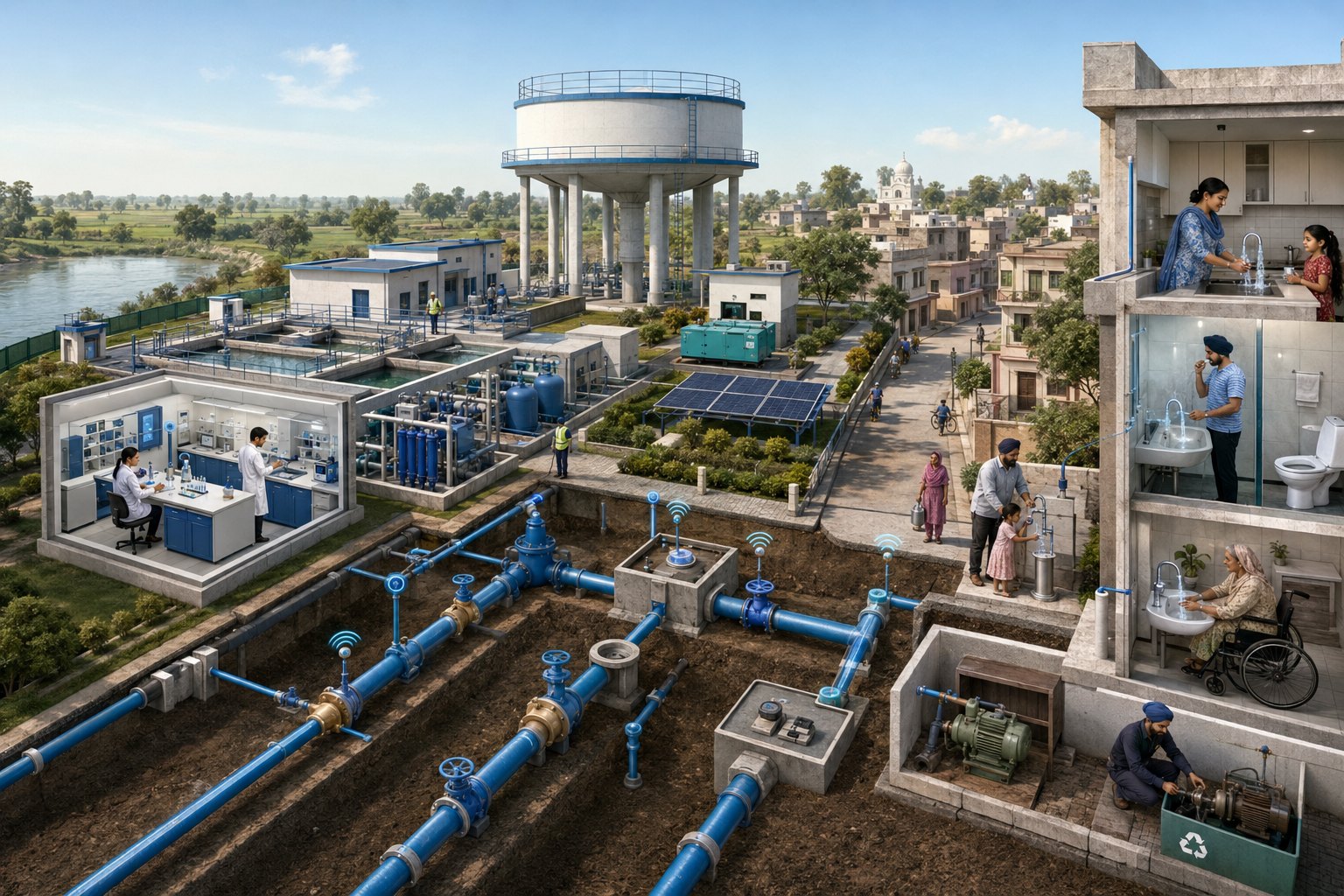
How the Direct-Tap System Would Work
- 1
Sustainable Water Source
Assess canal, surface and groundwater sources for long-term availability and protection of the source area.
- 2
Treatment and Filtration
Screening, sedimentation, filtration and disinfection sized for the population served.
- 3
Laboratory Quality Testing
Routine sampling against applicable Indian drinking-water standards, with dated published results.
- 4
Treated-Water Storage
Covered clear-water reservoirs and elevated service tanks that buffer demand and outages.
- 5
Pressure-Controlled Distribution
Pressure zones and control valves so upper floors and line-end homes receive the approved service level.
- 6
Leak Detection and Repair
District metering areas and acoustic sensors to find losses early and repair them on a published timeline.
- 7
Household Service Connection
A properly sized, backflow-protected connection with a shut-off valve at every home.
- 8
Continuous Monitoring
Pressure, flow, chlorine residual and pump performance monitored around the clock.
- 9
Public Reporting and Complaints
A tracked complaint number for every report and a public performance dashboard.
Engineering Components
Design, materials and operation would follow the latest applicable Indian drinking-water, public-health, electrical and engineering standards.
Water-treatment plants
Sized for present and projected demand.
Protected reservoirs
Covered, secured and regularly cleaned.
Elevated service tanks
Gravity head for steady household pressure.
Pressure zones
Zone-wise control instead of one uniform line.
Modern distribution pipes
Corrosion-resistant, jointed to reduce leakage.
Backflow prevention
Stops contaminated water re-entering mains.
District metering areas
Measure losses network area by area.
Leak-detection sensors
Find hidden underground losses early.
Quality-testing laboratories
Accredited testing with published results.
Backup generators and renewable energy
Keep pumping running during power cuts.
Emergency water storage
Reserve supply for repairs and disasters.
Preventive maintenance
Scheduled asset care instead of breakdown repair.
Accessible public taps
Usable by elderly, disabled and wheelchair users.
Fire-flow planning
Hydrant capacity planned with the network.
Applicable standards and authoritative sources
- IS 10500 — Drinking Water Specification (Bureau of Indian Standards)
- Jal Jeevan Mission — Operational Guidelines, Government of India
- CPHEEO Manual on Water Supply and Treatment, Ministry of Housing and Urban Affairs
- Central Ground Water Board — Punjab groundwater reports
- Central Electricity Authority — safety and electrical regulations
No Motor Removal Before Reliable Service
Before any household motor is phased out, every one of the following must be verified in that area.
- The household connection works.
- Water quality meets applicable standards.
- Pressure meets the approved engineering service level.
- Published supply hours are consistently maintained.
- Backup arrangements work during power failure.
- An emergency supply plan exists.
- Complaint tracking is operational.
- Independent technical verification is complete.
- Residents receive adequate written notice.
- Vulnerable households receive installation assistance.
Residents must not be forced to surrender private equipment without lawful authority, notice and an approved transition process.
- Safe disconnection
- Approved recycling
- Trade-in or transition assistance where funded
- Retaining permitted emergency storage tanks
- Appeal and complaint review
Reduce Household Electricity Burden
Removing the need for separate household booster motors may reduce household electricity use, maintenance costs, electrical hazards and noise. However, the public waterworks system will still require energy for treatment and pumping.
Measure and publish
- Previous household motor electricity use
- Public-system energy use
- Energy used per unit of treated water
- Solar or renewable contribution
- Pump efficiency
- Leakage losses
- Verified net energy impact
Learn Internationally—Design for Punjab
- Professionally managed water utilities
- Pressure-controlled networks
- Continuous water-quality monitoring
- Preventive asset maintenance
- Public service standards
- Transparent billing
- Leak detection
- Emergency response
- Public performance reports
- Clear operator responsibility
Punjab should adopt suitable technical and management practices, not copy foreign laws, costs or infrastructure without local assessment.
Affordability and Access
- Transparent connection charges
- Publicly approved tariffs
- Affordable essential household supply
- Support for legally eligible vulnerable households
- No discriminatory service
- Accessible taps and complaint channels
- Written billing explanations
- Leak alerts before unusually high bills
- Appeal process
- No arbitrary disconnection
Smart meters may be used for
- Detecting leaks
- Measuring network performance
- Understanding demand
- Transparent billing where lawfully approved
Important clarification
Smart meters are not automatic permission to increase charges. Any tariff change would require a separate, publicly approved process.
Pilot-First Implementation
No budget figures or completion dates are claimed here. Each phase must be completed and verified before the next begins.
Phase 1
Survey
Survey existing sources, pipes, pressure, water quality, electricity use and household motors.
Phase 2
Pilot selection
Select representative rural, town and urban pilot areas through published criteria.
Phase 3
Upgrade
Upgrade treatment, storage, distribution, monitoring and complaint systems.
Phase 4
Verify
Verify water quality, pressure, reliability, affordability and energy performance.
Phase 5
Voluntary transition
Begin voluntary motor-disconnection and recycling only in successfully verified areas.
Phase 6
Independent audit
Conduct an independent audit and public review before expansion.
Public Water Dashboard
A proposed public dashboard would show system performance. Private household consumption would never be published.
- Water-quality test results
- Test location and date
- Supply schedule
- Pressure status
- Service interruptions
- Repair status
- Leakage rate
- Complaint reference status
- Energy performance
- Last verified date
Report a Water-Supply Problem
Tell us where and when the problem happens so it can be raised with the responsible department.
Policy notice
This is a proposed policy for technical study and public consultation. Household motors would be phased out only after safe, reliable, adequately pressurized and independently verified direct-tap service is operating.