Punjab First
From Dependency to Self-Reliance
Build strong citizens through productive agriculture, value-added food industries, skills, employment and farmer participation in price decisions.
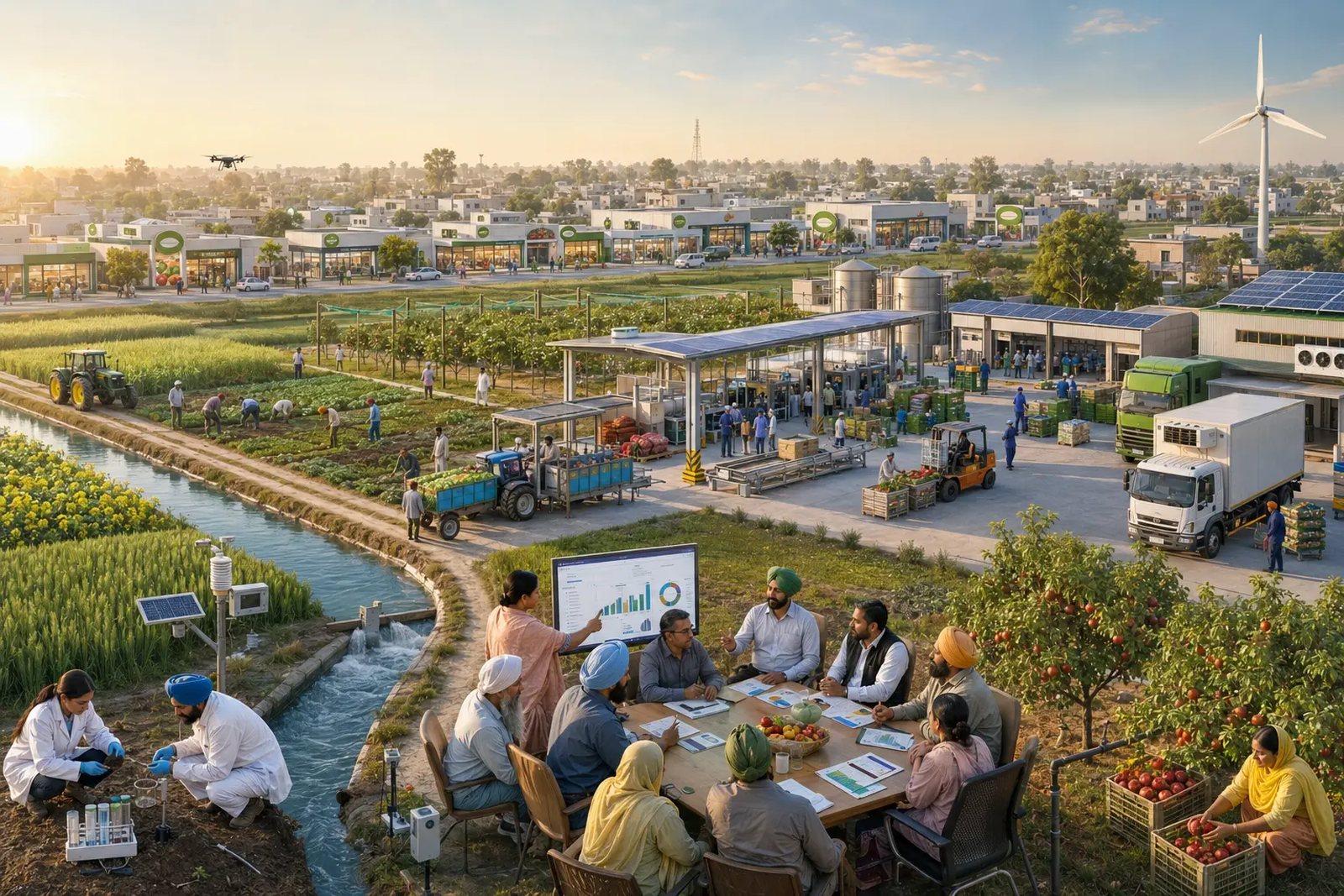
TPP proposes voluntary agricultural production clusters, farmer-owned processing systems and a statewide network of 2,100 proposed community grocery stores for Punjab-grown products.
Core Policy Position
The Triangle Party of Punjab proposes replacing long-term dependence on poorly targeted and financially unsustainable giveaways with education, healthcare, skills, employment, productive assets, responsible enterprise and income-generating opportunities.
Not every public service or social protection is a “free scheme”. We distinguish four different categories:
1. Essential public services
Education, healthcare, emergency services and basic civic infrastructure. These are public duties, not giveaways.
2. Lawful social protection
Support for eligible elderly persons, persons with disabilities, children, extremely vulnerable households and other legally protected groups.
3. Productive support
Skills, shared agricultural machinery, irrigation, processing, entrepreneurship and employment.
4. Poorly targeted or duplicative giveaways
Schemes that require independent financial and social-impact review before any decision is taken.
No scheme may be ended abruptly
Before any scheme is changed, all of the following would be required:
- Legal review
- Beneficiary verification
- Social-impact assessment
- Public consultation
- Transition arrangements
- Budget analysis
- Protection against severe hardship
Strong Citizens, Not Permanent Dependency
The objective is not to abandon vulnerable people. The proposed transition would protect essential services and lawful social safeguards while shifting public investment toward education, health, employable skills, productive assets, responsible credit and sustainable livelihoods.
Quality education
Strong public schools and colleges that prepare students for work, enterprise and civic life.
Reliable healthcare
Dependable public health services so that illness does not push a family into debt.
Employable skills
Training linked to real demand in agriculture, food processing, trades, services and technology.
Productive employment
Work that creates value close to home, in villages as well as towns.
Responsible enterprise
Small and cooperative businesses that follow law, food-safety standards and fair dealing.
Financial capability
Savings, insurance, responsible credit and household financial literacy.
Review Before Reform
Every existing scheme would be evaluated against the following:
- Legal status
- Purpose
- Eligible beneficiaries
- Actual number of beneficiaries
- Annual cost
- Funding source
- Measurable outcome
- Duplication with other schemes
- Fraud or leakage risk
- Consequence of withdrawal
- Proposed replacement or transition
- Independent audit findings
A scheme is never marked for closure solely because it is free at the point of use.
Voluntary 100-Acre Agricultural Production and Processing Groups
Groups of farmers may voluntarily coordinate adjoining or nearby holdings to access shared planning, machinery, irrigation, storage, processing and market services while preserving lawful land ownership and documented rights.
These are not private “farmhouses”. The correct term is: Agricultural Production and Processing Clusters.
Mandatory safeguards
- Participation must be voluntary.
- No forced acquisition or land pooling.
- Land ownership remains legally protected.
- Written agreements in the farmer’s language.
- Independent legal advice before signing.
- Clear profit, cost and loss-sharing rules.
- Freedom to exit under agreed conditions.
- Women landowners and tenant farmers must be represented.
- No transfer of title through blank or unclear documents.
- Dispute-resolution and audit procedures.
- Environmental and groundwater safeguards.
Cluster facilities (proposed)
Soil and water testing
Crop planning
Diversification
Shared machinery
Precision irrigation
Renewable energy
Collection and grading
Cold storage
Food processing
Packaging and branding
Quality certification
Market and logistics support
From Crop to Branded Punjab Product
- 01
Farmer planning
- 02
Production
- 03
Collection
- 04
Testing and grading
- 05
Storage
- 06
Processing
- 07
Packaging
- 08
Distribution
- 09
Retail sale
- 10
Transparent payment and audit
Possible product categories
No product will be described as organic unless it is officially certified.
Proposed Network of 2,100 Punjab Community Grocery Stores
TPP proposes studying the feasibility of a statewide network of up to 2,100 retail outlets for verified Punjab-grown and Punjab-processed products.
These stores do not exist yet. No locations have been decided.
Required before implementation
- Demand and location study
- Pilot programme
- Independent financial model
- Capital and operating-cost estimates
- Food-safety licences
- Procurement policy
- Inventory and waste controls
- Digital billing and audit
- Transparent franchise or cooperative rules
- Accessibility standards
- Competition-law review
- Protection against political appointments
- No unfair exclusion of existing local retailers
Store purposes
- Direct market access for farmers
- Transparent product origin
- Local processing jobs
- Fair and published procurement terms
- Quality-controlled food
- Reduced unnecessary intermediaries
- Consumer feedback
- Digital inventory and payment records
Farmers Must Participate in Price Decisions
Farmers should have a structured and transparent role in price discussions. Prices must consider verified production costs, quality, storage, processing, transport, market conditions and a reasonable producer margin.
Farmers cannot unilaterally impose a price on consumers or private markets; participation means a transparent, structured consultation.
Proposed price-review panel
- Elected farmer representatives
- Women farmer representatives
- Agricultural economists
- Cost-accounting specialists
- Processor representatives
- Consumer representatives
- Market and logistics experts
- Independent audit observer
Proposed price formula
- Verified production cost
- + quality adjustment
- + storage and processing
- + transport and retail cost
- + reasonable producer margin
- = transparent proposed selling price
Illustrative formula—subject to law, market review and public consultation.
Employment Beyond the Farm
Food technology
Quality testing
Machine operation
Refrigeration
Packaging
Warehousing
Transportation
Retail management
Accounting
Software and inventory systems
Sales and exports
Repair and maintenance
Implementation Phases
- 1
Independent scheme, land, water, market and legal assessment.
- 2
Voluntary farmer consultation and pilot-cluster selection.
- 3
Small-scale processing, storage and retail pilots.
- 4
Independent evaluation of income, cost, water use and market performance.
- 5
Legislative, budget and public review before expansion.
No fixed deadlines or budgets will be announced before formal approval.
Proposed Measurement Dashboard
If implemented, progress would be published against these indicators. Personal farmer financial information would never be published.
- Farmer participation
- Average net farm income
- Farmer payment time
- Water use per acre
- Crop diversification
- Processing volume
- Storage losses
- Jobs created
- Women’s participation
- Retail operating cost
- Product rejection rate
- Consumer satisfaction
- Audit exceptions
Official Reference Sources
For any agricultural, price, processing, food-safety or water statistic, please consult these official sources.
- Department of Agriculture and Farmers’ Welfare, Government of Punjab
- Commission for Agricultural Costs and Prices (CACP), Government of India
- Ministry of Food Processing Industries, Government of India
- Food Safety and Standards Authority of India (FSSAI)
- Central Ground Water Board — groundwater assessment reports
Policy notice
This page presents a proposed policy for public consultation. The 100-acre clusters and 2,100-store network are not existing programmes or guaranteed outcomes. Implementation would require legal review, voluntary participation, feasibility studies, environmental safeguards, approved budgets and independent oversight.