Clean Streets • Safe Power • Healthy Villages
Modern Underground Infrastructure for Punjab’s Villages
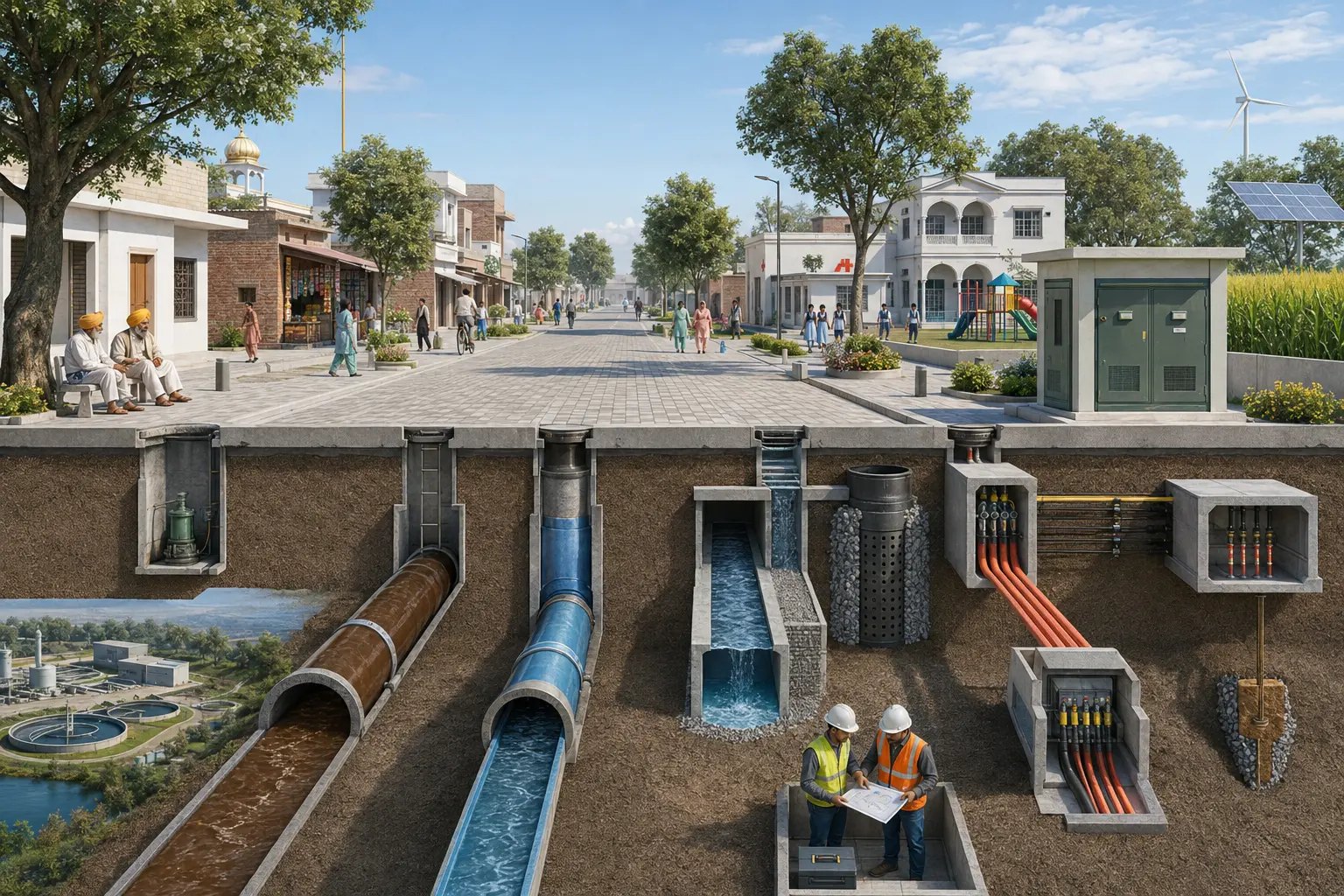
Replace open sewage drains and unsafe overhead distribution clutter through properly engineered, maintainable and accountable underground systems.
The Core Proposal
Phased modernization of village infrastructure through underground household sewerage, a separate stormwater system, underground electricity where technically feasible, safe separation from drinking-water pipelines, and treatment, maintenance, mapping and public accountability.
Every design must be adapted to Punjab’s conditions
- Monsoon rainfall
- Flood risk
- Groundwater levels
- Soil conditions
- Narrow village streets
- Existing buildings and utilities
- Agricultural requirements
- Affordability
- Indian laws and technical standards
Why Modernization Is Needed
01
Open Sewage Drains
Household wastewater runs through open street drains instead of sealed underground pipes.
02
Mosquitoes, Odour and Disease Risk
Standing wastewater near homes creates breeding sites, persistent smell and avoidable health risk.
03
Sewage Overflow During Rain
Where rainwater and sewage share the same drain, heavy monsoon flow pushes waste into streets and homes.
04
Unsafe Overhead Wires
Low, tangled and unmarked wires over narrow streets and rooftops create shock and fire hazards.
05
Storm and Tree Damage
Wind, storms and falling branches break overhead lines and cut supply for long periods.
06
Unmapped and Uncoordinated Utilities
Without accurate records, one department's work damages another department's lines.
07
Repeated Road Excavation
The same street is dug up again and again because utilities are not planned together.
08
Weak Maintenance and Complaint Response
Blockages and faults are attended late, and complaints are rarely tracked to closure.
Separate Networks for Safety and Reliability
Sanitary Sewerage
Carry household sewage through sealed pipes to an approved treatment facility.
Stormwater Drainage
Carry rainwater separately through inlets, drains, recharge structures and safe overflow routes.
Underground Electricity
Place technically suitable village-distribution cables inside protected, mapped and accessible underground conduits.
Mandatory rule
Never combine sanitary sewage and stormwater in the same pipe unless a qualified engineering assessment and applicable law specifically permit an existing combined system.
Do not place electricity conduits beside water or sewer lines without required safety separation.
Closed and Treated Village Sewerage
Proposed components
- Surveyed household connections
- Sealed gravity sewers
- Inspection chambers and manholes
- Pumping stations only where necessary
- Backup power
- Blockage-detection programme
- Mechanized cleaning
- Sewage-treatment plant
- Safe sludge management
- Treated-water quality testing
- Lawful reuse of treated water
- Emergency overflow plan
- Odour control
- Public maintenance schedule
Untreated sewage must never be discharged into
- Ponds
- Canals
- Fields
- Groundwater
- Village streets
- Stormwater drains
Human safety
Manual entry into sewers must be prohibited except where explicitly allowed by law under emergency safety procedures. Inspection and cleaning must be mechanized.
Monsoon-Ready Village Drainage
- Rainfall and flood-risk mapping
- Separate stormwater pipes
- Roadside collection inlets
- Silt traps
- Recharge structures where safe
- Village ponds restored for lawful stormwater management
- Overflow routes
- Regular pre-monsoon cleaning
- Protection against sewage cross-connections
- Flood-safe electrical installations
Do not send untreated sewage into recharge pits or village ponds.
Safer Underground Village Electricity
Proposed components
- Survey of existing loads and connections
- Underground protected cable conduits
- Compact distribution substations
- Safe transformers
- Earthing and surge protection
- Sectionalizing equipment
- Fault-detection systems
- Accessible distribution cabinets
- Cable route markers
- GIS-based utility maps
- Spare ducts for future capacity
- Streetlight connections
- Emergency isolation points
- Planned maintenance access
Important limitation
Do not claim that every transmission line can be placed underground. High-voltage transmission infrastructure must remain subject to specialized engineering and grid requirements.
Priorities
- Village low-voltage distribution
- Technically appropriate 11 kV distribution sections
- Congested streets
- Schools and health centres
- Accident-prone areas
- Areas affected by trees and storms
Expected Benefits
These are realistic improvements from good engineering and maintenance. No system can promise zero outages, zero flooding or zero blockages.
Cleaner streets
Lower disease risk
Reduced electrical accidents
Better monsoon drainage
Fewer visible wires
Improved reliability
Easier utility mapping
Better village appearance
Planned maintenance
Support for future digital infrastructure
Learn Internationally—Engineer for Punjab
- Separate sewer and stormwater networks
- Underground utility corridors
- Accurate asset maps
- Inspection access
- Preventive maintenance
- Electrical safety
- Service standards
- Emergency response
- Contractor accountability
- Public performance reporting
Punjab should adopt suitable engineering and management practices, not copy foreign construction costs, laws or designs without local assessment.
Applicable standards and authoritative sources
- CPHEEO Manual on Sewerage and Sewage Treatment, Ministry of Housing and Urban Affairs
- CPHEEO Manual on Storm Water Drainage Systems
- Swachh Bharat Mission (Grameen) — greywater and sanitation guidance
- Central Electricity Authority — Measures relating to Safety and Electric Supply Regulations
- Prohibition of Employment as Manual Scavengers and their Rehabilitation Act, 2013
- Central Pollution Control Board — effluent discharge standards
Pilot-First Implementation
No fixed deadlines or budgets are claimed here; those follow an approved detailed project report.
Phase 1
Map what exists
Map existing sewer, drains, drinking water, electricity, telecom and road infrastructure.
Phase 2
Technical studies
Complete soil, groundwater, monsoon, flood-risk and electrical-load studies.
Phase 3
Select pilot villages
Select pilot villages using published criteria.
Phase 4
Consult
Consult residents, Panchayats, utilities and technical experts.
Phase 5
Coordinated design
Prepare coordinated designs for all utilities before digging.
Phase 6
Build and inspect
Construct and independently inspect pilot systems.
Phase 7
Test
Test sewer flow, treatment, drainage, electrical safety and road restoration.
Phase 8
Publish before expansion
Publish costs, results, defects and maintenance requirements before expansion.
Construction Safeguards
- Maintain access to homes and businesses.
- Provide safe temporary walking routes.
- Protect children, seniors and persons with disabilities.
- Control dust, noise and construction waste.
- Prevent open unattended trenches.
- Coordinate all utilities before road excavation.
- Photograph and map every installed utility.
- Restore roads to published standards.
- Publish contractor name, contract value and progress.
- Require defect-liability and performance guarantees.
- Conduct third-party quality tests.
Public Infrastructure Dashboard
A proposed public dashboard would show project and performance information. Private household information would never be published.
- Village and project area
- Approved project stage
- Contractor and supervising authority
- Start and expected completion dates
- Approved budget
- Amount paid
- Work completed
- Sewer test results
- Treatment-plant status
- Electrical safety inspection
- Road-restoration status
- Complaints and resolution time
- Last independent inspection
- Last verified date
Report a Village Infrastructure Problem
Tell us where the problem is so it can be documented and raised with the responsible department.
Policy notice
This is a proposed policy for public consultation and technical feasibility assessment. Underground sewerage and electricity systems would be introduced in phases according to engineering suitability, safety, legal approvals, approved budgets and maintenance capacity.